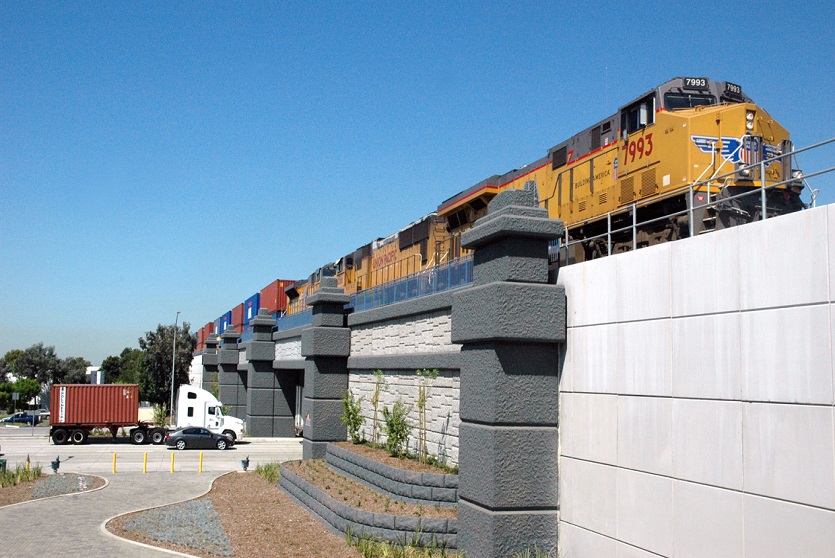
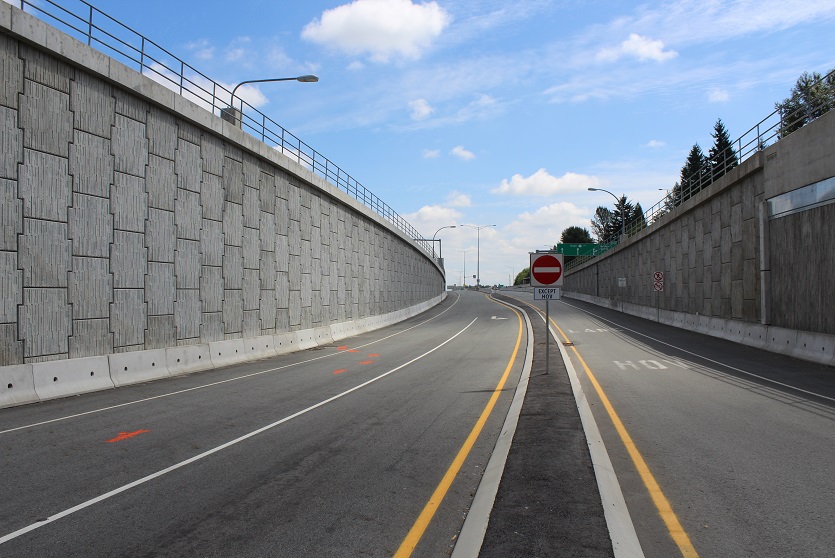
Roads, railways, levees and platforms often have to be built on ground that cannot safely carry them: soft compressible soils, foundations improved with piles or columns, or areas exposed to sinkholes and underground cavities. Without reinforcement at the base, the embankment risks sliding, spreading, settling unevenly or collapsing into a void.
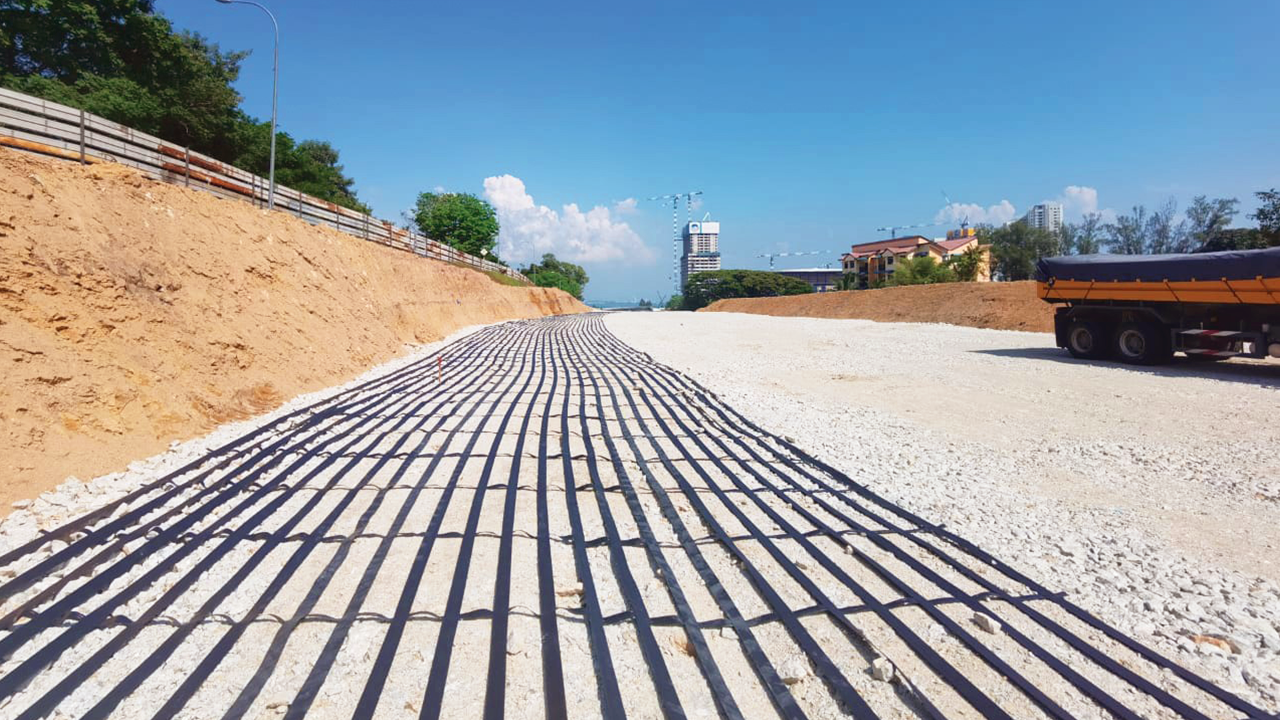
Basal reinforcement places a high-strength, low-strain reinforcing layer at the base of the embankment. It holds the fill together, controls settlement and keeps the structure stable over its service life. It often replaces slower and more costly approaches such as excavation and replacement, staged construction or closely spaced foundations.
Risks of building embankments on poor ground
- Low shear strength of the foundation
On soft soils, embankment stability depends mainly on the foundation’s resistance to shearing, which is often insufficient.
- Lateral spreading and sliding
The weight of the fill pushes the embankment outward and can trigger a slip through the soft layer.
- Total and differential settlement
Compressible ground settles over time, unevenly between areas, damaging pavements, tracks and transitions to structures.
- Sudden ground collapse
In karst areas, former mines or zones of groundwater extraction, cavities can open without warning beneath the embankment.
- Construction time and cost
Excavation and replacement, staged loading or dense piling slow down projects and require specialized equipment.
- Long service life
The reinforcement must keep its strength and limit creep for the entire design life of the structure.

How reinforcement at the base keeps embankments stable
An embankment is an engineered earth fill with two side slopes and a core, usually built from granular soils. When it rests on weak or uncertain ground, a reinforcing layer placed at its base works in tension. It resists the lateral thrust of the fill, spreads loads across the foundation and bridges areas of weak or missing support. High-strength geogrids such as ArmaLynk are used for this role, often combined with separation and filtration geotextiles such as ArmaForce.
The reinforcement may be used on its own, on natural soft ground, or as part of a load transfer platform above piles and columns. It can also be designed to span a potential cavity if the ground beneath gives way. In every case, the aim is the same: a stable embankment, controlled settlement and fewer, simpler foundation works.
Basal reinforcement is used for road and railway embankments, bridge approaches and ramps, airport platforms, levees, dikes and canals, and storage and industrial areas. Depending on the foundation, it falls into three main configurations: void over bridging, embankments on soft soils, and embankments on rigid inclusions.
Basal reinforcement configurations
- Embankments on soft soils
On soft, compressible ground, a single high-strength reinforcing layer at the base of the embankment increases the safety factor against sliding and foundation failure. It also limits lateral spreading and differential settlement.
This configuration allows embankments to be built faster, sometimes with steeper side slopes and a narrower footprint. It reduces the need for excavation and replacement, staged construction or chemical treatment. Even on moderately soft ground, the reinforcement adds lasting benefits in separation, drainage and stability. Geogrids such as ArmaLynk are designed for this use.
- Embankments on rigid inclusions
When soft soils are improved with piles, stone columns or controlled modulus columns, a load transfer platform is placed on top of the inclusions. This is a layer of selected granular fill reinforced with high-strength, low-strain geosynthetics. It concentrates the embankment loads onto the pile or column heads through arching in the fill, and limits differential settlement between them.
This approach allows wider spacing between inclusions, fewer piles and faster construction than concrete slabs or closely spaced piles. It is particularly suited to bridge approaches, ramps and tank foundations, where settlement tolerances are strict. ArmaLynk is commonly used for this reinforcement.
- Void over bridging
In karst regions, former mining areas or zones of groundwater extraction, a cavity can collapse suddenly beneath an embankment. A high-strength, low-strain reinforcing layer placed at the base is designed to span the potential void. It keeps the surface deformation within acceptable limits and maintains the structure’s integrity if the ground gives way.
This configuration provides a safety margin for road and railway lines crossing uncertain ground, where a sudden collapse would put users at risk. The design is based on the expected diameter of the cavity, the loads above and the acceptable surface deflection. ArmaLynk is used alone or combined with a load transfer platform.
Parameters for sizing basal reinforcement
- Foundation soil properties: Shear strength, compressibility and thickness of the weak layer govern stability and settlement.
- Embankment geometry: Height, crest width and side slope angles set the loads and the lateral thrust to be resisted.
- Loads and traffic: Static, dynamic and surcharge loads from roads, railways or storage areas define the reinforcement strength required.
- Settlement tolerances: Acceptable total and differential settlement, especially near bridges and structures, guide the choice between reinforcement alone and a load transfer platform.
- Ground improvement layout: For rigid inclusions, spacing, cap size and the thickness of the granular platform interact with the reinforcement design.
- Cavity risk: Expected void diameter and probability of collapse determine the strength and stiffness needed for bridging.
- Long-term behaviour: Creep, durability and chemical environment set the reinforcement grade over the design life.
- Drainage and separation: Water conditions and fine soils may require geotextiles or drainage layers in addition to the reinforcement.