Households, industries and mines produce huge volumes of waste every year. Solid refuse, fly ash, residual muds, sludge and tailings all have to be stored somewhere, often for decades, without contaminating the soil, groundwater or surrounding land.
Waste storage covers the structures that receive, confine and hold this material: landfill cells and their expansions, tailings embankments, dewatering areas, lined ponds and transfer stations. Environmental regulations are strict, available land is limited, and every cubic meter of storage capacity counts.
Constraints of storing waste over the long term
- Limited land and capacity
Existing sites run out of space, and new land for storage is difficult to obtain.
- Protection of soil and groundwater
Leachate, contaminated water and fine particles must stay within the storage area.
- Stability of high fills
Waste masses and tailings are heavy, compressible and often weak, which puts the confining embankments under strain.
- Wet and fluid materials
Sludge, dredged material and residual muds hold large volumes of water that must be separated before disposal.
- Regulatory requirements
Storage sites must meet strict rules for lining, drainage, monitoring and closure.
- Operations on an active site
Structures are built while trucks, conveyors and treatment processes keep running.
Confining waste safely from delivery to closure
A waste storage site combines structures with different roles. Some receive the waste, others confine it, and others separate water from the material or isolate it from the ground. Each one has to stay stable and watertight for as long as the waste remains on site.
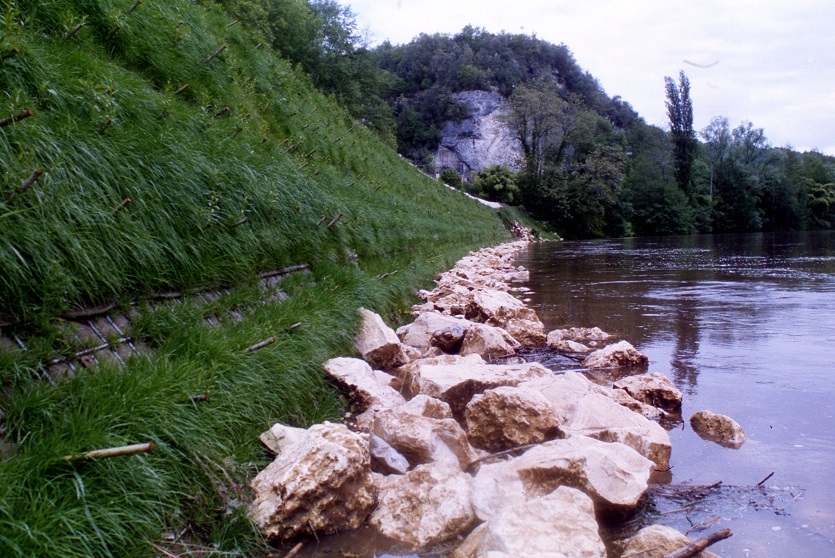
Vertical walls and steep slopes increase storage capacity within the same footprint. Reinforced Earth walls and abutments are used for perimeter walls, cell dividers, landfill expansions and elevated dumping platforms, while Reinforced Earth slopes raise embankments with a vegetated or mineral face from the Architectural finish range. On soft or compressible ground, high-strength geogrids such as ArmaLynk and ArmaGrid reinforce the base of embankments and tailings dams.
For fluid materials, geotextile tubes contain sludge, fly ash and dredged material while letting the water drain out, leaving the solids ready for disposal. Ponds, basins and lagoons are sealed with geosynthetic clay liners and protected with geotextiles such as ArmaForce, while drainage geocomposites collect leachate and gas.
Waste storage is found at municipal landfills, mine sites, power plants, wastewater treatment plants and industrial facilities, for new sites as well as expansions and closures.
Waste storage facilities
- Landfill cells and expansions
Walls and steep reinforced slopes that create or increase storage volume within the existing site boundary.
- Tailings and waste embankments
Confining dykes and embankments that retain mining tailings and industrial residues, often built on soft ground.
- Sludge dewatering and containment
Geotextile tubes that hold residual muds, sludge and dredged material while the water drains out.
- Lined ponds and lagoons
Sealed basins for wastewater, sludge and leachate, protecting the ground and groundwater beneath.
- Transfer and dumping stations
Elevated platforms retained by walls, where trucks unload waste into bays or containers.


Factors that shape a waste storage project
- Type of waste: Solid, granular or fluid, hazardous or non-hazardous, the material defines confinement and lining needs.
- Storage volume and footprint: Target capacity and available land guide the choice between slopes, steep slopes and vertical walls.
- Waste mass behaviour: Settlement, weight and low strength of the stored material affect the stability of confining structures.
- Foundation conditions: Soft or compressible ground under dykes and embankments may require reinforcement at the base.
- Watertightness and drainage: Liners, leachate collection and gas management protect the environment and keep the site stable.
- Chemical environment: Aggressive leachate and residues influence the choice of reinforcements, geosynthetics and concrete.
- Phasing: Storage sites grow in stages, so structures must allow future raising or extension.
- Closure and integration: Capping, revegetation and landscape integration prepare the site for the end of operations.